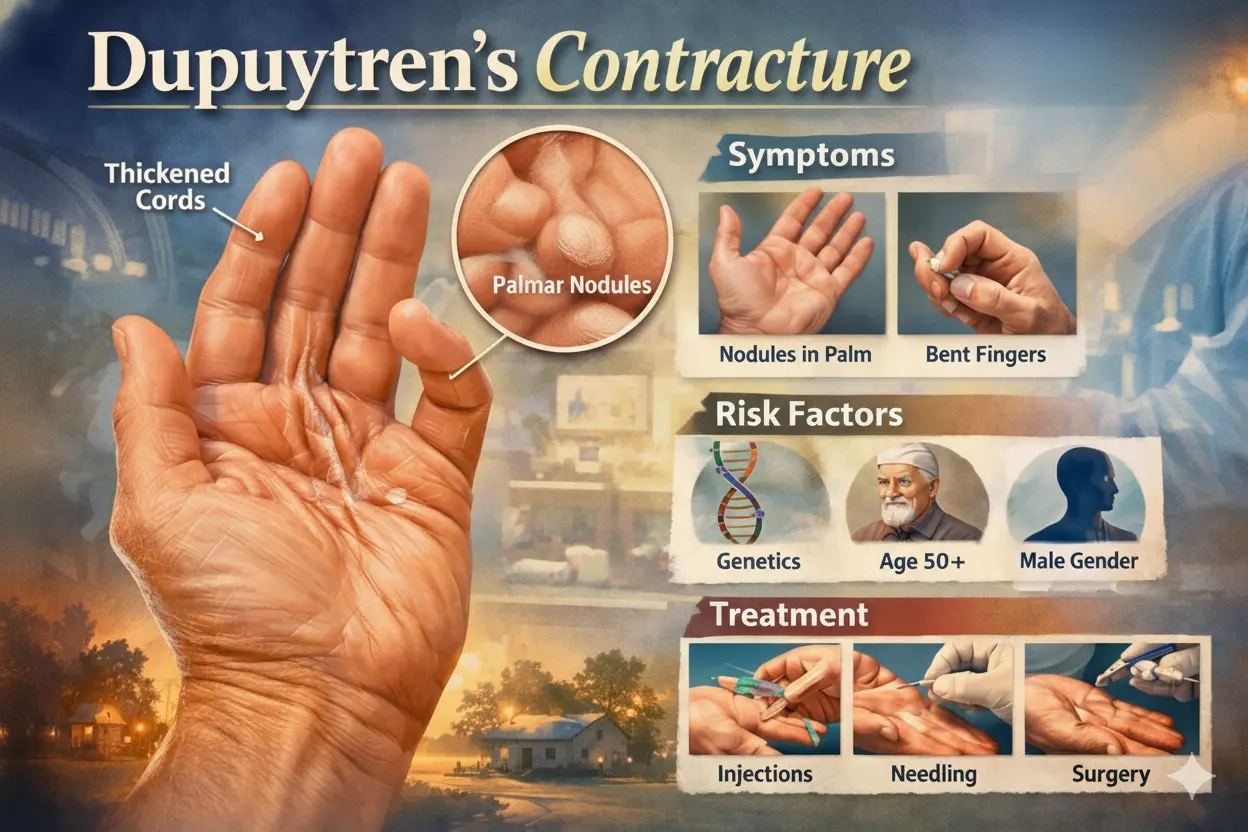
Loguytren problems, commonly identified in medical terms as Dupuytren’s contracture, describe a gradual hand condition that affects finger movement. It develops beneath the skin of the palm, where connective tissue thickens over time. As this tissue tightens, it forms bands that slowly pull the fingers toward the palm, reducing the ability to fully open the hand.
The condition usually develops quietly. Many people live with early signs for years before noticing any real limitation. However, as finger bending increases, routine actions such as holding objects, writing, shaking hands, or placing the palm flat on a surface may become difficult.
Dupuytren’s contracture does not affect bones, joints, or tendons. The issue lies within the palmar fascia, a fibrous layer under the skin that loses its flexibility over time.
How Loguytren Problems Start in the Hand
The earliest changes occur deep within the palm. Collagen, a protein responsible for tissue structure, begins to build up abnormally. This leads to thickened areas under the skin that gradually shorten and tighten.
Initially, these changes are subtle and often painless. Small hardened areas may appear in the palm, but finger movement usually remains normal. Over months or years, the tissue forms cord-like structures that extend toward the fingers and begin pulling them inward.
The ring finger and little finger are most often affected, although other fingers can also be involved in advanced cases.
Factors That Increase the Risk of Dupuytren’s Contracture
Although the precise trigger behind Loguytren problems remains unclear, certain patterns are well recognised.
People over the age of 40 are more likely to develop symptoms, with progression becoming more noticeable as age increases. Men experience the condition more often than women and may see faster tightening of the fingers.
Family history plays a strong role. Individuals with relatives who have Dupuytren’s contracture face a higher likelihood of developing similar changes. The condition is also seen more frequently among people of Northern European ancestry.
Certain health conditions are linked to higher risk, including diabetes, long-term alcohol use, smoking habits, and seizure disorders. In some individuals, similar tissue thickening occurs in other areas of the body, such as the soles of the feet or the genital region.
Signs and Symptoms of Loguytren Problems
Symptoms usually progress in stages.
In the early phase, firm nodules form in the palm. These nodules may feel rough or thickened but are usually not painful. The skin over them may appear puckered or tight.
As the condition advances, fibrous cords develop and extend from the palm into the fingers. These cords shorten over time, leading to finger bending that becomes increasingly difficult to reverse.
In later stages, fingers may remain permanently bent, limiting grip strength and hand flexibility.
When Loguytren Problems Begin to Affect Daily Life
Many people seek medical care once hand function starts to decline. Difficulty placing the hand flat on a table, holding cutlery, using a keyboard, or putting on gloves are common reasons for consultation.
Because Dupuytren’s contracture progresses slowly, early assessment allows better planning and monitoring before severe stiffness develops.
How Dupuytren’s Contracture Is Identified
Diagnosis is primarily based on physical examination. A healthcare professional examines the palm and fingers to detect nodules, cords, and loss of extension.
One common assessment involves checking whether the hand can rest flat on a surface. Imaging scans are rarely required unless another hand condition is suspected.
Available Treatment Options for Loguytren Problems
Treatment decisions depend on how much finger movement is restricted and whether daily activities are affected.
In early or mild cases, regular observation may be sufficient. When finger bending becomes noticeable, non-surgical treatments may be used. These include injections that soften the cords or needle-based procedures that release tight tissue.
For advanced cases with significant contracture, surgery may be needed to remove or release the affected fascia. Surgical treatment often improves finger position, though recovery and hand rehabilitation are part of the process.
Managing Life With Dupuytren’s Contracture
Living with Loguytren problems involves staying aware of hand changes and maintaining mobility where possible. Gentle hand stretching may support flexibility, although it does not stop disease progression.
After treatment, hand therapy can help restore strength and movement. Regular follow-ups are helpful to track changes, as recurrence is common over time.
Long-Term Outlook and Possible Challenges
Dupuytren’s contracture often returns after treatment, particularly in individuals with strong family history or more severe disease. Some people may require repeated procedures over the years.
Without treatment, finger bending may continue slowly, reducing hand function. However, many individuals experience slow progression and maintain usable hand movement for long periods.
Frequently Asked Questions About Loguytren Problems
Is Dupuytren’s contracture genetic?
Family history increases risk, but inheritance patterns vary.
Is Dupuytren’s contracture painful?
Pain is uncommon. Most difficulty comes from limited movement.
Can lifestyle changes stop Loguytren problems?
Lifestyle changes may reduce risk factors but do not fully prevent the condition.
Can exercises reverse Dupuytren’s contracture?
Exercises help mobility but do not remove thickened tissue.
Final Overview
Loguytren problems, known clinically as Dupuytren’s contracture, cause gradual tightening of the palm that limits finger movement. Although the condition progresses slowly, early awareness and appropriate care help preserve hand function. If persistent palm thickening or finger bending appears, professional evaluation allows timely planning and management.